
more Mainstream Apologetics ...

Evidence ID: BIB-EV78
Evidence: Autograph Reconstruction from 24,000 Manuscripts
Summary: The New Testament autographs are reconstructed from approximately 24,000 early copies or fragments written during the first few centuries. Textual criticism is applied to reconcile 138,000 word/phrase variants. After the variants have been classified as unintentional orthographic errors and intentional changes, only 40 lines of the 20,000 lines that comprise the New Testament are in question. This results in an accuracy of 99.8%. Compared with Homer's Iliad, the next most-copied book, the New Testament is 25 times more accurate.
Description:
With approximately 24,000 copies or fragments of the New Testament,
it would seem an insurmountable task to reconstruct an accurate reproduction of the
original autographs.
Thankfully, through the systematic use of biblical criticism, most notably historical
and textual criticisms, this reconstruction effort is tractable.
To reconstruct an ancient text accurately, scholars need lots of copies, and early copies. This has been developed into a science, called textual criticism [BIB-EV02]. The key is to keep going back to the earliest known copies.
The oldest fragment of the New Testament is a tiny piece of the gospel of John, dating from around 125 AD, copied just three decades after John’s original composition. It is called the John Ryland’s papyrus P52. Other ancient portions of the New Testament include the Bodmer papyri P66 (200 AD) and the Chester Beatty papyri (250 AD). The oldest complete (or nearly complete) copies of the New Testament are the Codex Vaticanus and Codex Sinaiticus, both from around 340 AD and 400 AD, respectively.
In fact, the dates of some of the earliest New Testament fragments are within 25 years of the autographs. [REF-NTM01], [REF-DBW01] This places some manuscripts within the lifetime of those who may have eye witnessed the actual events being written about.
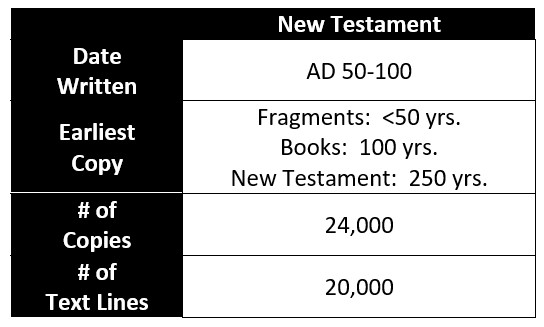
The manuscripts of the New Testament consisted of fragments or books. Fragments are dated between 15 to 50 years after the autographs. Complete books of the New Testament are dated less than 100 years after the autographs.
Moreover, the early church fathers of the 2nd century quoted the New Testament so extensively and often that apparently all but eleven New Testament verses are found in quoted writings. In other words, one could put together the entire New Testament just from the quotations from the early church fathers [REF-GEI04].
A summary of all New Testament variants is presented in Table 2 [REF-QRY01].
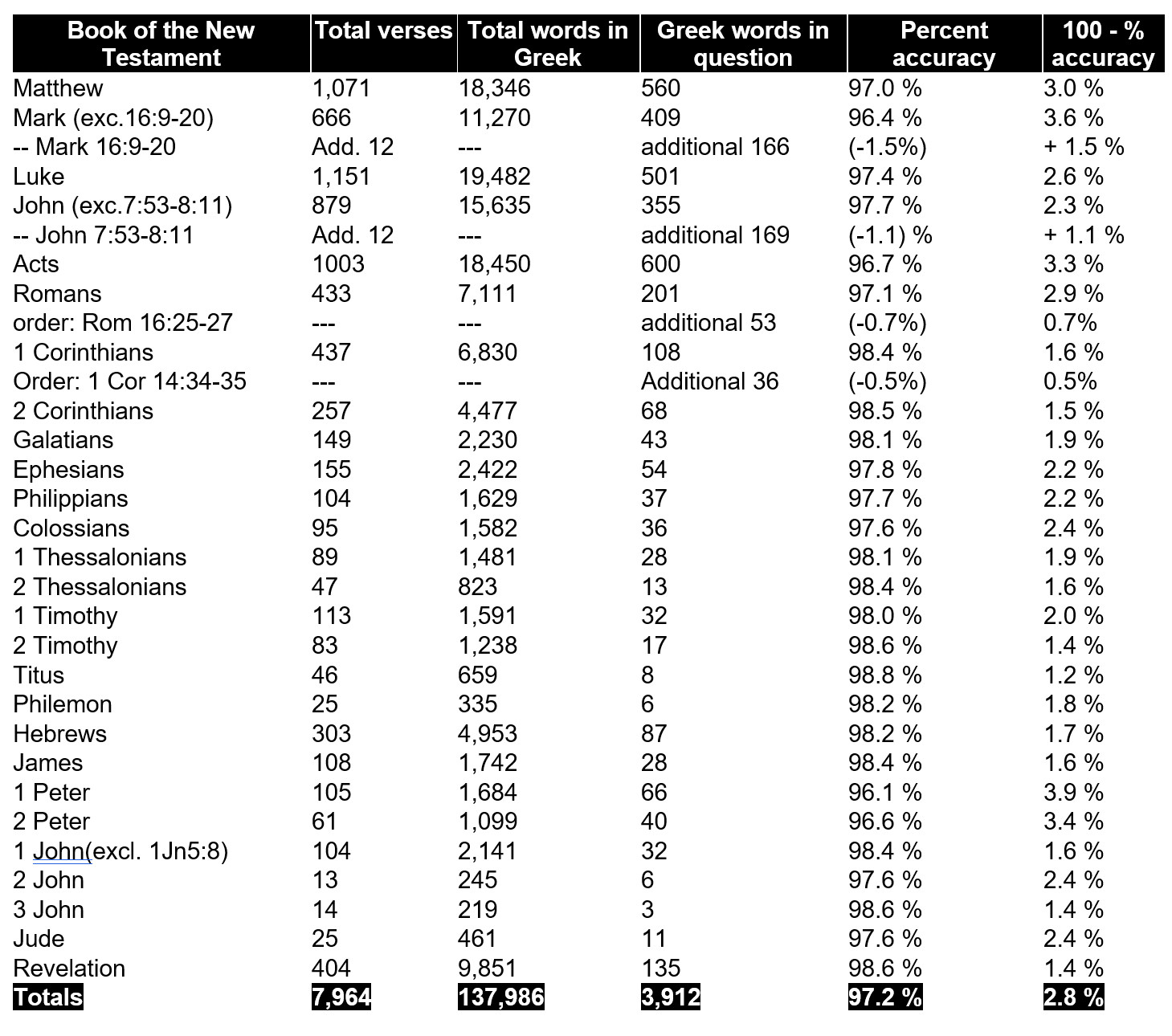
Textual critics studied the variations within the manuscripts to decide whether those differences represent unintentional orthographic errors (e.g. misspellings, words inadvertently omitted, punctuation errors, minor word transpositions) or intentional changes involving grammar smoothing or various word/phrase changes. The latter category of intentional changes is only found in 38 places with 10 or more word changes [REF-QRY01]. All remaining variants are unintentional orthographic errors.
According to Geisler and Nix,
"Once the counting procedure is understood, and the orthographic variants have been eliminated, the remaining significant variants are surprisingly few in number. In fact, most of the variants found in the early Christian manuscripts have nothing to do with theology or ideology. Far and away most variants are a result of mistakes pure and simple - slips of the pen, accidental omissions, inadvertent additions, misspelled words, blunders of one sort or another." [REF-GEI03]
The New Testament is estimated as being 99.8% accurate. This is based on the fact that only 40 lines (400 words) are in question of the 20,000 lines that comprise the New Testament. Therefore, only an estimated 0.2% of the lines - 40 divided by 20,000 lines - are in question [REF-GEI03].
So, how does the New Testament compare with Homer's Iliad?
Homer’s Iliad is the next most-copied book of the ancient world. It has almost the same number of lines of text as the New Testament. It has more extant manuscripts than any other book besides the New Testament. It was considered sacred, was written in Greek, and underwent textual changes and criticism much like the New Testament manuscripts.
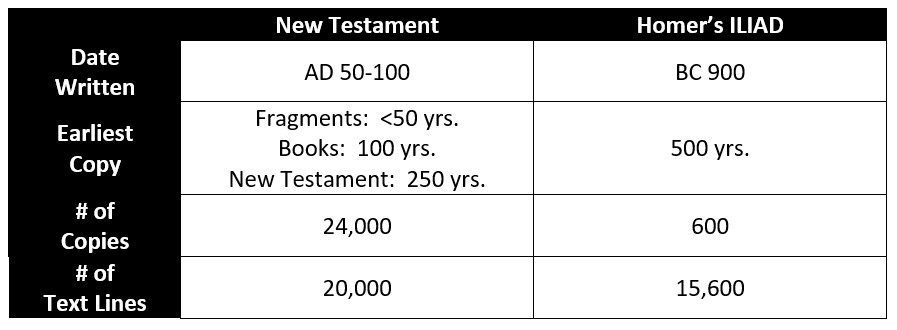
By comparison, Homer's Iliad only has 600 copies or fragments. The number of New Testament copies and fragments is astounding—nearly 4000% more than Homer's Iliad!
In terms of accuracy, Homer's Iliad has 764 lines in question of a total of 15,600 lines [REF-GEI03]. This is equivalent to a 4.9% error or 95.1% accuracy. Therefore, the New Testament is 25 times more accurate than Homer's Iliad!
Resources:
Copyright@2026 Mainstream Apologetics